
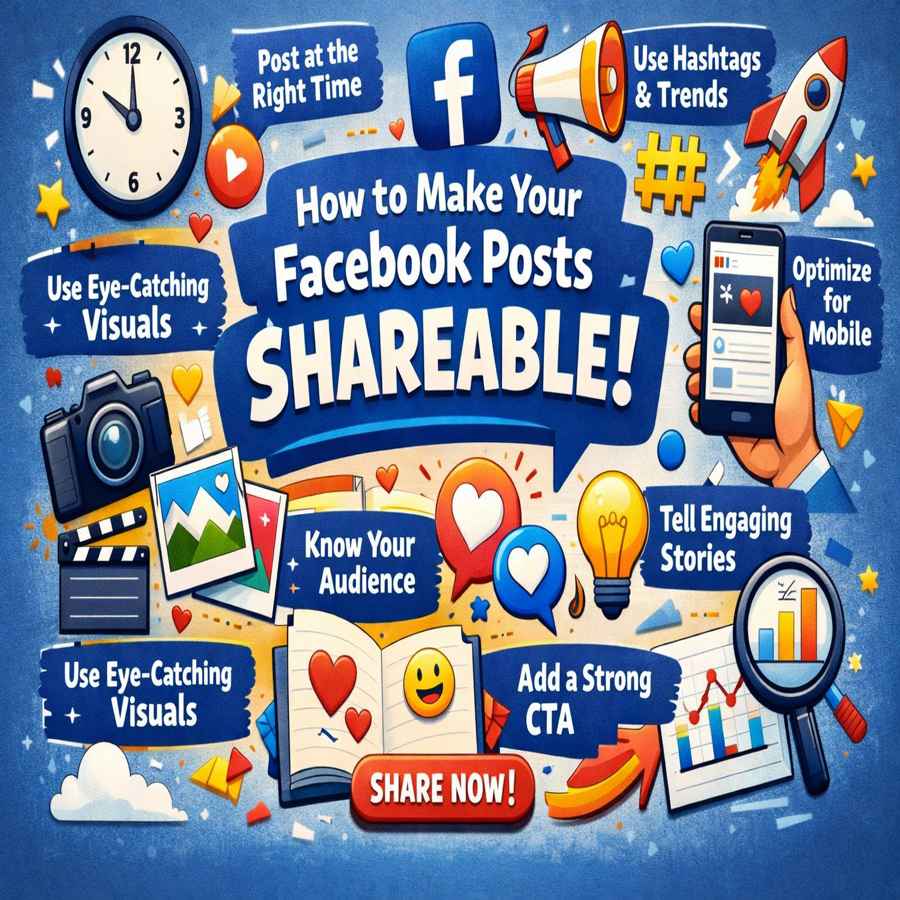
Creating a shareable Facebook post is one of the most powerful ways to grow your online presence. When people share your content, it reaches new audiences without any extra cost. This helps you increase engagement, attract more website traffic, and build long-term brand awareness.
In today’s competitive social media world, posting randomly is not enough. You need a clear strategy to make your content stand out.
In this article, you will learn practical and proven techniques to make your Facebook posts more shareable. From understanding your audience to writing strong headlines and using emotional storytelling, this guide will help you create content that people truly want to share.
Why Facebook Shares Are Important
On Facebook, users can interact with posts in three main ways:
- Likes show quick appreciation
- Comments start conversations
- Shares spread your content to new audiences
Among these actions, shares are the most valuable.
When someone shares your post, it appears on their timeline and in their friends’ news feeds. This gives your content free promotion and helps you reach people who do not follow you yet.
Facebook’s algorithm also favors posts that receive more shares. When your content is shared frequently, Facebook shows it to more users, which increases your organic reach and visibility.
For businesses, content creators, and personal brands, Facebook shares provide many benefits:
- More website traffic
- Higher brand credibility
- Better audience trust
- Stronger online reputation
- Increased lead generation
Simply put, more shares mean more growth.
Understand Your Audience First
Before creating any Facebook post, you must clearly understand your audience. If you do not know who you are speaking to, your content will not connect.
Start by identifying:
- Age group
- Location
- Interests
- Profession
- Online habits
- Buying behavior
Next, think about their emotions, challenges, and goals. Ask yourself:
- What problems are they facing?
- What solutions are they looking for?
- What inspires or motivates them?
- What type of content do they enjoy?
You can use Facebook Insights and social media analytics tools to study your audience behavior. These tools show:
- Which posts perform best
- When your audience is active
- What type of content gets more engagement
When you create posts based on real audience needs, people feel understood. As a result, they are more likely to like, comment, and share your content.
Create High-Quality and Valuable Content
High-quality content is the foundation of every successful Facebook strategy. No matter how good your design or headline is, weak content will not get shared.
Your posts should always be:
- Useful
- Informative
- Entertaining
- Relevant
- Trustworthy
Let’s look at three main types of shareable content.
Educational Content
Educational posts help users learn something new. People love sharing helpful information because it makes them look smart and supportive.
Examples of educational content include:
- Step-by-step guides
- How-to tutorials
- Expert tips
- Industry updates
- Case studies
- Statistics and facts
For example:
“5 Simple Ways to Improve Your Facebook Marketing Today”
This type of content builds authority and positions you as an expert in your field.
Entertaining Content
Entertaining posts are light, fun, and easy to consume. They help your brand feel friendly and relatable.
Popular entertaining formats include:
- Memes
- Short videos
- Funny images
- GIFs
- Relatable quotes
- Trending challenges
People often share entertaining content to make others smile. However, make sure your humor matches your brand voice and audience expectations.
Professional brands should avoid offensive or misleading jokes.
Inspirational Content
Inspirational posts connect deeply with emotions. They encourage people to believe in themselves and take action.
Examples include:
- Success stories
- Motivational quotes
- Personal experiences
- Customer testimonials
- Business journeys
For example:
“From Failure to Success: How This Small Business Grew in One Year”
These posts are powerful because people share them to inspire others.
Write Attention-Grabbing Headlines
Your headline is the first thing users see. If it is boring, they will scroll past without reading.
A strong headline should:
- Create curiosity
- Promise clear value
- Solve a problem
- Feel personal and relevant
Focus on the first line of your post. It should immediately capture attention.
Examples of Strong Facebook Headlines
- “You Won’t Believe These Simple Marketing Tips”
- “This One Trick Can Double Your Engagement”
- “Are You Making These Facebook Mistakes?”
- “How I Gained 10,000 Followers in 30 Days”
Use numbers, questions, emotional words, and benefits to increase clicks and shares.
Use Eye-Catching Visuals
Visual content is essential for social media success. Posts with images or videos receive more engagement than text-only posts.
Importance of Images and Videos
Visuals help you:
- Increase engagement rate
- Improve message clarity
- Make posts memorable
- Build brand identity
- Boost shareability
Best Image Sizes for Facebook
To maintain quality, use the right dimensions:
- Square images: 1080 × 1080 pixels
- Landscape images: 1200 × 630 pixels
- Video ratio: 1:1 or 16:9
Correct sizing improves appearance on both mobile and desktop devices.
Tips for Attractive Visuals
- Use bright and clean colors
- Add readable text overlays
- Keep layouts simple
- Use consistent brand colors
- Avoid blurry images
- Use high-resolution photos
Tools for Creating Graphics
You can design professional visuals using:
- Canva
- Adobe Express
- Crello
- Figma
These tools are beginner-friendly and help you create social media designs quickly.
Add Emotional Appeal
People do not share content because of logic alone. They share content because of emotions.
Emotional marketing is one of the strongest ways to increase Facebook shares.
Why Emotional Posts Perform Better
Emotional posts create personal connections. When users feel something, they remember your message and want others to feel it too.
Types of Emotions That Work
The most effective emotions include:
- Joy and happiness
- Surprise and curiosity
- Empathy and care
- Motivation and hope
- Inspiration and pride
Examples of Emotional Hooks
- “This story will change how you see success”
- “Every small business owner needs to read this”
- “I wish I knew this earlier in my life”
Use emotional language naturally. Avoid fake stories or exaggeration, as this can damage trust.
7. Keep Your Message Clear and Simple
Social media users scroll quickly. If your post is difficult to read, they will ignore it.
Simple writing always performs better.
Tips for Clear Content
- Use short sentences
- Keep paragraphs small
- Avoid technical words
- Remove unnecessary details
- Focus on one main message
Formatting Tips
Good formatting improves readability:
- Use line breaks
- Add bullet points
- Highlight key ideas
- Use emojis carefully 😊
Example:
✅ Save time
✅ Grow faster
✅ Increase sales
This format makes your post easy to scan.
Include a Strong Call-to-Action (CTA)
A call-to-action tells users what to do next. Without it, many people will leave without interacting.
Ask for Shares Naturally
Never force your audience. Instead, invite them politely.
Examples:
- “Share this with someone who needs it”
- “Tag a friend who will love this”
- “If you agree, share your thoughts”
- “Save and share for later”
When and How to Use CTAs
- Place your CTA at the end
- Keep it friendly and simple
- Match it with your goal
- Avoid overusing CTAs
A well-written CTA increases engagement and encourages organic sharing.
Post at the Right Time
Even the best content can fail if it is posted at the wrong time. Timing plays a critical role in social media visibility, reach, and engagement.
When you publish your posts at the right moment, more people see them, interact with them, and share them.
Importance of Timing
When your content appears while your audience is active, it receives immediate attention. This leads to:
- More likes and reactions
- Higher comment activity
- Increased shares and reach
- Stronger engagement rate
- Better algorithm performance
On the other hand, posting when users are offline can cause your content to disappear quickly in crowded news feeds.
Best Posting Times (General Guidelines)
Although every audience behaves differently, research and industry studies suggest the following time frames often perform well:
- Weekdays: 9:00 AM – 12:00 PM and 6:00 PM – 9:00 PM
- Weekends: 10:00 AM – 1:00 PM
- Best Days: Tuesday, Wednesday, and Thursday
These are general benchmarks. Your ideal schedule may vary depending on your location, niche, and audience behavior.
How to Test and Find Your Ideal Schedule
To discover the best posting time for your page:
- Review Facebook Insights regularly
- Track engagement patterns
- Publish posts at different times
- Compare reach and interaction
- Analyze performance weekly
With consistent testing, you will identify the time slots when your audience is most responsive.
Use Trending Topics and Hashtags
Trending topics help your content become part of active conversations. When you connect your posts with popular discussions, your visibility increases naturally.
Using hashtags strategically also improves content discovery and search visibility.
Finding Trending Topics
You can discover trending topics through:
- Facebook Trending section
- News websites
- Google Trends
- Twitter/X trending lists
- Industry publications and blogs
Always choose trends that align with your brand, values, and audience interests.
Using Hashtags Properly
Hashtags help Facebook categorize and distribute your content.
Best practices include:
- Use 2–5 relevant hashtags
- Keep hashtags short and readable
- Match hashtags with your topic
- Use branded hashtags when possible
Example:
#SocialMediaTips #FacebookMarketing #DigitalGrowth
Well-chosen hashtags increase reach without harming professionalism.
Avoiding Hashtag Spam
Overusing hashtags makes your posts look unprofessional and reduces credibility.
Avoid patterns like:
❌ #Like #Follow #Share #Post #Viral #Trending #Best
Instead, focus on quality, relevance, and clarity.
Leverage Storytelling Techniques
Storytelling is one of the most powerful tools in digital marketing. People remember stories far longer than plain information.
Well-crafted stories inspire trust, emotion, and action.
Why Stories Go Viral
Stories perform well because they:
- Create emotional connections
- Build authenticity and trust
- Feel personal and relatable
- Inspire sharing
- Encourage empathy
When readers connect emotionally, they naturally want to share your message.
Structure of a Good Story
A strong Facebook story usually follows this structure:
- Introduction – Set the scene
- Problem – Present the challenge
- Solution – Show your action
- Result – Share the outcome
- Lesson – Provide value
This framework keeps readers engaged from start to finish.
Adding Personal or Customer Experiences
Authentic stories increase credibility and engagement. Use examples such as:
- Your business journey
- Customer success stories
- Personal struggles and growth
- User testimonials
- Behind-the-scenes moments
Real experiences feel genuine and build emotional impact.
Optimize for Mobile Users
Most Facebook users browse the platform on smartphones. If your content is not optimized for mobile, you will lose engagement opportunities.
Mobile optimization is no longer optional—it is essential.
Why Mobile Optimization Matters
Mobile-friendly posts:
- Load faster
- Display properly
- Improve readability
- Increase shares
- Enhance user experience
Poor mobile design leads to high bounce rates and low interaction.
Writing Mobile-Friendly Posts
Follow these guidelines:
- Use short paragraphs
- Break content into sections
- Avoid long text blocks
- Use simple language
- Highlight key ideas
Mobile users prefer fast, scannable content.
Designing Mobile-Ready Visuals
For best mobile performance:
- Use square or vertical formats
- Keep text large and bold
- Avoid tiny fonts
- Center important elements
- Test designs on different devices
Always preview visuals before posting.
Engage With Your Audience
Engagement is the foundation of a loyal online community. When followers feel valued, they become long-term supporters and content sharers.
Replying to Comments
Always interact when possible:
- Answer questions clearly
- Thank users sincerely
- Like positive feedback
- Address criticism respectfully
Active communication builds trust.
Encouraging Conversations
Stimulate discussions by asking open-ended questions:
- “What do you think?”
- “Have you tried this?”
- “Share your experience”
- “Which option do you prefer?”
Questions increase comment activity and algorithm reach.
Building a Sharing Community
Create loyalty by:
- Posting consistently
- Staying authentic
- Supporting followers
- Sharing user-generated content
- Highlighting community members
Strong communities share content naturally and repeatedly.
15. Analyze and Improve Your Performance
Successful social media marketing is data-driven. Without analysis, growth becomes unpredictable.
Tracking Post Performance
Use professional tools such as:
- Facebook Insights
- Meta Business Suite
- Social media analytics platforms
Review performance regularly.
Key Metrics to Watch
Focus on these engagement indicators:
- Reach
- Impressions
- Shares
- Comments
- Likes
- Click-through rate (CTR)
- Engagement rate
These metrics reveal what resonates with your audience.
Learning From Successful Posts
Study your best-performing posts and ask:
- What topic worked?
- Which format performed best?
- Which headline attracted clicks?
- What emotion was triggered?
Repeat proven strategies.
Common Mistakes to Avoid
Avoiding mistakes protects your brand reputation and audience trust.
Clickbait Without Value
Misleading headlines create disappointment and reduce credibility. Always deliver what you promise.
Over-Promotional Content
Constant selling drives followers away. Focus on education, inspiration, and value first.
Poor-Quality Images
Low-resolution visuals damage professionalism. Always use clear, high-quality designs.
Ignoring Audience Feedback
Feedback is valuable data. Learn from criticism and improve continuously.
Examples of Highly Shareable Facebook Posts
Let’s examine real examples of high-performing posts.
Business Example
Post:
“Here’s how we helped 1,000 customers grow in 6 months.”
Why it worked:
- Clear results
- Social proof
- Educational value
- Trust-building message
Personal Example
Post:
“I failed three times before I succeeded. Here’s what I learned.”
Why it worked:
- Honest storytelling
- Emotional connection
- Relatable journey
Viral Example
Post:
“A simple life lesson everyone needs to hear today.”
Why it worked:
- Curiosity-driven headline
- Emotional appeal
- Universal relevance
Bonus Tips for More Shares
Use these additional strategies to maximize reach.
Using Facebook Groups
Join niche-related groups and share helpful content. Focus on value, not promotion.
Collaborating With Influencers
Partner with relevant influencers to access new audiences and build credibility.
Running Share-Based Contests
Example:
“Share this post to enter our giveaway.”
This boosts reach quickly when done ethically.
Cross-Posting Strategies
Promote content across platforms:
- Twitter/X
This drives multi-channel traffic.
19. Conclusion
Making your Facebook posts truly shareable requires creativity, consistency, analysis, and strategic thinking.
To succeed, remember to:
- Post at optimal times
- Use trends wisely
- Apply storytelling techniques
- Optimize for mobile users
- Engage actively
- Monitor performance
- Avoid common mistakes
There is no universal formula for viral success. Every audience is unique. The key is continuous testing, learning, and improvement.
Start applying these proven strategies today. With patience and dedication, your Facebook posts can reach wider audiences, build stronger relationships, and support long-term digital growth.
